
Article by Dr. John Churchill.
One of the central problems confronting contemporary spiritual culture is not simply whether particular teachers are ethical, whether certain retreats are overpriced, or whether modern spiritual communities have become too commercialized. The deeper issue concerns the organizational form through which spiritual teaching now moves. In many traditional settings, the teacher existed within a larger institutional structure: a monastery, temple, church, lineage, order, or school. These structures often contained serious problems of their own. They could be hierarchical, authoritarian, patriarchal, and closely tied to the political forms of the societies in which they developed. Yet they also provided a container larger than the personality of the individual teacher. The teacher, the teaching, the treasury, the lineage, the community, and the institution were not necessarily identical.
Modern spirituality has disrupted this arrangement. In many respects, this disruption has been necessary. Traditional religious institutions frequently preserve forms of authority that belong to earlier social worlds. They may contain profound contemplative technologies and centuries of accumulated wisdom while remaining organized according to structures inherited from feudal, monarchical, or highly stratified societies. As modern and postmodern culture has challenged those forms, many of the most creative spiritual teachers have emerged outside traditional institutions. They have translated old teachings, developed new practices, integrated psychology and science, and addressed questions that inherited traditions were often poorly equipped to answer.
Yet the departure from traditional institutional structures has created a new problem. When the teacher leaves the monastery, church, or lineage structure, the teacher frequently enters the marketplace. Once this happens, the conditions of the market begin to shape the form of spiritual transmission. The teacher must now sustain an organization, attract students, generate income, maintain visibility, and compete for attention. There is nothing inherently wrong with teachers being paid or with spiritual organizations developing sustainable economic models. The difficulty arises when the financial survival of the teaching becomes inseparable from the continual concentration of attention, loyalty, and money around the teacher.
This is the structural problem at the heart of much contemporary spiritual culture. The market rewards visibility, repetition, brand recognition, exclusivity, and ongoing engagement. A spiritual teacher operating independently is therefore subtly encouraged to become not only a teacher, but also the central brand, economic engine, symbolic authority, and organizing principle of the institution. The result can be a system in which the distinction between the teacher and the teaching gradually collapses. The organization no longer exists primarily to transmit a body of knowledge or to move students through a developmental process. It begins to exist around the continued presence and centrality of the teacher.
The problem is therefore not simply that spiritual teachers charge too much money. Price alone does not tell us whether an institution is healthy. A costly training may be justified if it pays several qualified teachers, funds scholarships, supports long-term research, sustains infrastructure, and guides students through a coherent educational process. Conversely, an inexpensive teaching can still foster dependency and reinforce unhealthy authority structures. The more important question is what the economic system rewards.
A market-based spiritual organization tends to benefit when people remain engaged with the same teacher. Repeated attendance generates income. Continued admiration generates visibility. Greater visibility attracts more students. The teacher’s reputation increases, and access to the teacher can itself become more valuable. In this way, attention becomes a form of capital. The structure begins to reward a chain of dependence: attention produces loyalty, loyalty produces repeat participation, repeat participation increases the value of proximity, and proximity can then be monetized through increasingly exclusive forms of access.
A genuine educational system should produce almost the opposite movement. Its purpose should be to develop students toward increasing competence, autonomy, responsibility, and eventually graduation. A successful teacher should make the student less dependent upon the teacher, not more. A successful institution should increasingly distribute knowledge and authority rather than continually concentrating them. This does not mean that deep teacher-student relationships are inherently problematic or that long-term mentorship should disappear. It means that the relationship should be developmental. The student should progressively acquire capacities that were initially located in the teacher.
This distinction reveals the importance of organizational design. A sincere and compassionate teacher can still become embedded in a structure that creates dependency because the economics of the institution reward dependency. The problem does not necessarily begin with conscious exploitation. It can emerge gradually from the demands of sustaining an organization. If the survival of the community depends upon the continued attraction of the teacher, then the teacher must continue to attract. If the financial system depends upon students repeatedly returning to the same source, then the institution is rewarded for retaining them. The result can be a conflict between the educational purpose of the teaching and the economic needs of the organization.
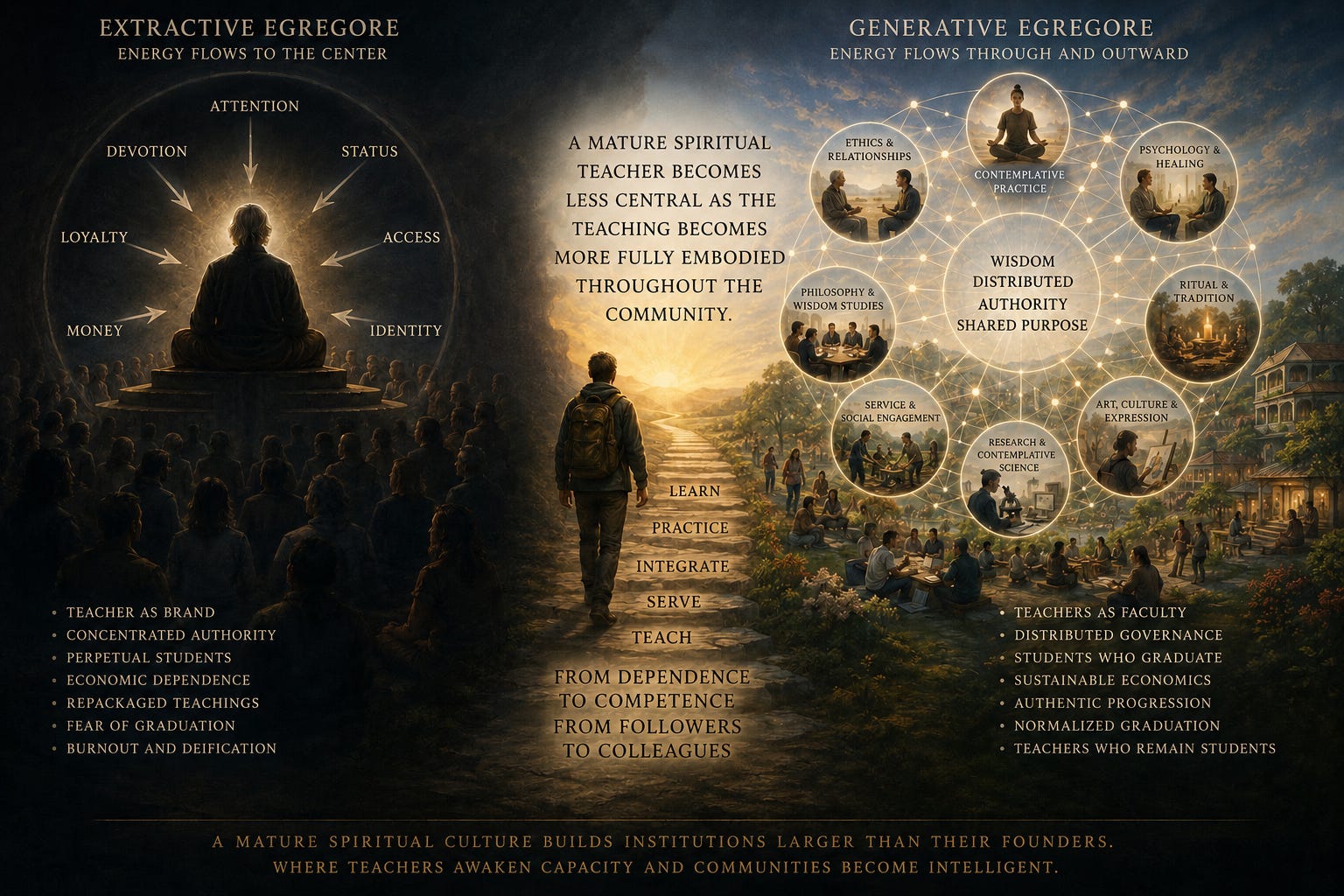
The traditional concept of the egregore offers a useful language for understanding this dynamic. An egregore can be understood as the collective field formed by a community, institution, or shared symbolic world. In a modern interpretation, this field is not merely mystical or energetic. It includes the stories a community tells about itself, the emotional bonds among its members, the reputation of the teacher, the distribution of authority, the financial flows, the rituals, the governance structure, and the patterns through which attention is organized. Every enduring spiritual organization generates such a field.
The question is therefore not whether a spiritual community creates an egregore, but what kind of egregore it creates. An extractive egregore continually directs energy toward the center. Students direct their attention, devotion, money, and aspiration toward the teacher; the organization amplifies the teacher; the amplified teacher attracts more students; and the cycle repeats. A generative egregore, by contrast, directs energy through the teacher and then outward. The teacher awakens capacities in students; students develop competence; competence becomes responsibility; responsibility becomes teaching, service, research, or cultural production; and the intelligence of the whole community increases.
This suggests that the central question in evaluating a spiritual teacher should not be limited to the teacher’s personal qualities. Whether a teacher is wise, compassionate, charismatic, or spiritually accomplished remains important, but it is insufficient. We must also ask what kind of social organism forms around that person. Does the teacher create people who become increasingly capable of standing on their own? Does authority become more distributed over time? Can the organization distinguish the founder’s gifts from the permanent needs of the institution? Can students move onward when they have learned what that teacher has to teach? Can the teacher themselves continue to develop?
These questions require us to reconsider the proper role of the teacher. The problem with contemporary guru culture is not that teachers exist or that differences in realization and competence exist. Any serious educational system must recognize expertise. Some teachers have practiced for decades. Some have deep contemplative realization. Others have unusual capacities for philosophical synthesis, psychological insight, ritual, ethical formation, or subtle forms of transmission. Denying these differences in the name of equality does not produce maturity. It merely obscures genuine competence.
The more important task is to locate the teacher within a larger educational ecology. The teacher should function as a catalyst rather than as the permanent center of the organism. In the early stages of an organization, a founder may necessarily hold many functions at once. The same person may teach, design curriculum, manage finances, make strategic decisions, and hold the vision of the whole community. This concentration may be unavoidable at the beginning. But maturation requires differentiation. Teaching should gradually become distinct from governance. Governance should become distinct from finance. Curriculum should become distinct from personality. Pastoral care should become distinct from organizational loyalty. A founder may continue to play an important role, but the institution should progressively become capable of functioning without requiring the founder to remain the source of every major decision and every significant form of meaning.
This process can be understood almost biologically. A young organism begins from a relatively undifferentiated state and gradually develops distinct organs. In the same way, a mature spiritual institution should develop separate capacities for teaching, governance, finance, research, mentorship, stewardship, and community leadership. If every function remains concentrated in the founder, then the institution never truly becomes an organism. It remains an extension of the founder’s personality.
This organizational problem is closely related to another major weakness in contemporary spirituality: the absence of a larger curriculum. A single teacher cannot teach the entirety of human development. One teacher may be excellent at introducing meditation. Another may understand trauma and psychological integration. Another may be capable of teaching concentration or subtle-body practices. Another may specialize in ethics, relational development, philosophical inquiry, contemplative realization, or social engagement. These are different capacities, and there is no reason to assume that mastery in one implies mastery in all.
The problem is that when a larger educational system is absent, each teacher is pressured to become a complete system. A successful meditation teacher gradually becomes a teacher of psychology, ethics, relationships, cosmology, leadership, and social transformation. The teacher’s personal body of work expands until it appears to constitute an entire path. This may happen partly through genuine development, but it may also occur because the teacher and organization need to retain students who would otherwise move elsewhere.
A more mature model would understand teachers as occupying different classrooms within a larger school. Some teachers teach foundational material. Others teach intermediate or advanced work. Still others specialize in particular domains. The point is not that one teacher is spiritually superior because they teach more advanced students. A brilliant primary-school teacher is not inferior to a university professor. Indeed, foundational education may carry even greater importance because everything else depends upon it.
This classroom metaphor changes the nature of spiritual authority. Rather than asking who the greatest or most enlightened teacher is, we begin asking what a particular teacher is actually qualified to teach, what capacities students should develop through their work, what should precede that teaching, and what should follow it.
Once we adopt this educational perspective, another problem becomes obvious: many spiritual communities have no meaningful concept of graduation. In a healthy school, students are expected to move through stages. They complete one level and proceed to another. They encounter different teachers. Eventually they may specialize, become practitioners in their own right, or enter the teaching profession themselves. Movement is built into the structure.
Many contemporary spiritual organizations do not operate this way. A student discovers a teacher, attends an introductory retreat, and then moves into more advanced offerings with the same teacher. The advanced offering leads to an intensive. The intensive leads to a teacher training. The teacher training leads to an inner circle or more exclusive form of participation. This progression can sometimes represent real deepening, but structurally there is often no point at which the organization tells the student that they have learned what this teacher is particularly capable of teaching and should now study elsewhere.
This is where the economic contradiction becomes particularly acute. If an organization loses revenue whenever a student graduates, then the institution is punished for fulfilling its educational purpose. It becomes economically advantageous to continually generate additional layers of participation. The same fundamental lesson can be repackaged in progressively advanced forms, allowing the student to remain within the same orbit. The teacher continues teaching the same developmental grade, while the institution renames the classroom.
A mature spiritual educational system would need to normalize graduation. Teachers should be honored for helping students reach a point at which another teacher or another field of study becomes more appropriate. Organizations should be capable of referring students to one another without experiencing that movement as economic loss or betrayal. Students should be able to say that they have completed a stage of training and moved onward without being treated as disloyal. Eventually, some students should become colleagues rather than remaining permanent disciples.
This leads to perhaps the most neglected dimension of the entire problem: the teacher also needs a path. The teacher-centered system does not only extract from students. It can also become profoundly extractive toward teachers themselves.
Once a teacher becomes the symbolic center of a community, the expectations placed upon that person multiply. The teacher is expected to teach, inspire, counsel, lead, mediate conflict, raise money, embody the values of the community, produce new material, maintain public visibility, and remain psychologically stable. The teacher may become responsible for the livelihoods of employees and the financial survival of retreat centers or organizations. Students project onto the teacher the image of wisdom, stability, compassion, or realization. The teacher may gradually lose the freedom to change because too many people depend upon the continuation of the role they are already playing.
The most dangerous moment may come when the teacher ceases to have teachers. Where can a spiritual teacher once again become a student? Who is authorized to challenge them? Who can tell them that they are wrong? Where can they withdraw, practice, fail, or reconsider? What happens when their students become highly developed and begin to approach them in competence? If there is no larger system in which the teacher themselves occupies a developmental position, the teacher can become trapped inside the projection of mastery.
This helps explain why spiritual communities that begin with genuine insight can later develop significant shadow problems. As students mature, some inevitably begin to see the limitations of the teacher. Others may become capable of challenging the teacher intellectually or spiritually. If the structure requires the teacher to remain exceptional, such maturation can become threatening. Narcissistic inflation, secrecy, financial defensiveness, sexual misconduct, rivalries, authoritarianism, and doctrinal rigidity are often treated purely as personal moral failures. Personal responsibility matters, but these problems can also be understood as symptoms of an institution that has made genuine development structurally difficult for the teacher.
A healthier system would actively protect teachers from deification. Students naturally project onto teachers. A teacher may become a symbolic parent, healer, savior, sage, or embodiment of the student’s own unrealized potential. Such projection is psychologically understandable and can sometimes become useful material for spiritual practice. The danger arises when projection is fused with financial, organizational, and interpretive authority.
If the same individual who receives the student’s deepest projection also controls access to status, money, teaching authorization, community belonging, and institutional decision-making, the relationship becomes dangerously concentrated. No amount of personal virtue can reliably substitute for structural safeguards. A mature institution should therefore separate different kinds of power. Spiritual authority should not automatically confer financial authority. Charisma should not automatically confer governance authority. Foundership should not automatically confer permanent control.
The alternative is not a world without teachers. It is a world in which teachers function more like members of a faculty within a larger sacred educational system. Each teacher would have particular domains of competence. Some would specialize in foundational work, others in advanced contemplative practice, psychology, ethics, subtle-body systems, philosophy, social engagement, or cultural transformation. Teachers could refer students to one another. They could step away from teaching. They could remain students themselves. They could participate in peer structures and be held accountable by people they respect.
Within such a system, humility would no longer require pretending that teachers have no authority. It would mean understanding the scope of that authority. A mature teacher should be able to say: this is what I know; this is what I am qualified to teach; this is where my knowledge becomes limited; this other person understands the next stage better than I do. Such statements should not diminish a teacher’s credibility. They should become marks of genuine maturity.
The transition required in contemporary spiritual culture is therefore not simply from bad gurus to good gurus. It is from a teacher-centered model to an educational ecology large enough to contain teachers. The goal is not to abolish hierarchy, expertise, transmission, or deep mentorship. It is to embed them within institutions that can differentiate functions, distribute authority, graduate students, care for teachers, and survive the eventual absence of their founders.
The ultimate measure of a spiritual teacher may therefore be less dramatic than contemporary culture often assumes. We tend to ask whether the teacher has a powerful presence, whether their retreats are transformative, whether their ideas are original, or how many people follow them. These questions are not irrelevant. But they should be accompanied by another set of questions. What happens to the people around this teacher after ten or twenty years? Do students become increasingly dependent upon the teacher or increasingly capable of embodying the teaching themselves? Does knowledge remain concentrated at the center, or does intelligence begin appearing throughout the community? Does money continually flow toward charisma, or does it increasingly support education, service, practice, research, and the development of new teachers? Does the community produce followers, or does it produce mature human beings capable of becoming colleagues?
A teacher should not ultimately be judged only by the intensity of the experience they create. A teacher should also be judged by the kind of human and institutional development that remains when they are no longer in the room.
The deepest purpose of teaching is not to make the teacher indispensable. It is to transmit capacities that become increasingly independent of the teacher’s presence. A mature spiritual teacher becomes less central as the teaching becomes more fully embodied throughout the community. Their wisdom does not disappear; it becomes distributed.
The challenge facing contemporary spirituality is therefore to build institutional forms capable of receiving the genuine gifts of powerful teachers without converting those teachers into permanent centers of attention, authority, and economic dependence. Such structures would protect students from dependency and teachers from deification. They would allow teachers to specialize, students to graduate, elders to continue learning, and communities to become progressively more intelligent.
The teacher would remain essential, but in a different way: not as the sun around which the community must forever revolve, but as a temporary concentration of knowledge, realization, and care whose deepest purpose is to awaken those same capacities elsewhere.
Dr. John Churchill is the founder of Planetary Dharma, a contemporary Bodhisattva training school integrating perennial wisdom, contemplative practice, attachment healing, and adult development.
Thank you for this excellent article. As someone tangentially involved in the founding of a local Daoist teaching temple, I’ve sent it on to the others involved.
This article is so well stated that I wonder if you were secretly watching our sangha three years ago.