
Sensemaking in Funky Times
A field guide for sensemaking in an age of cosmological vertigo...

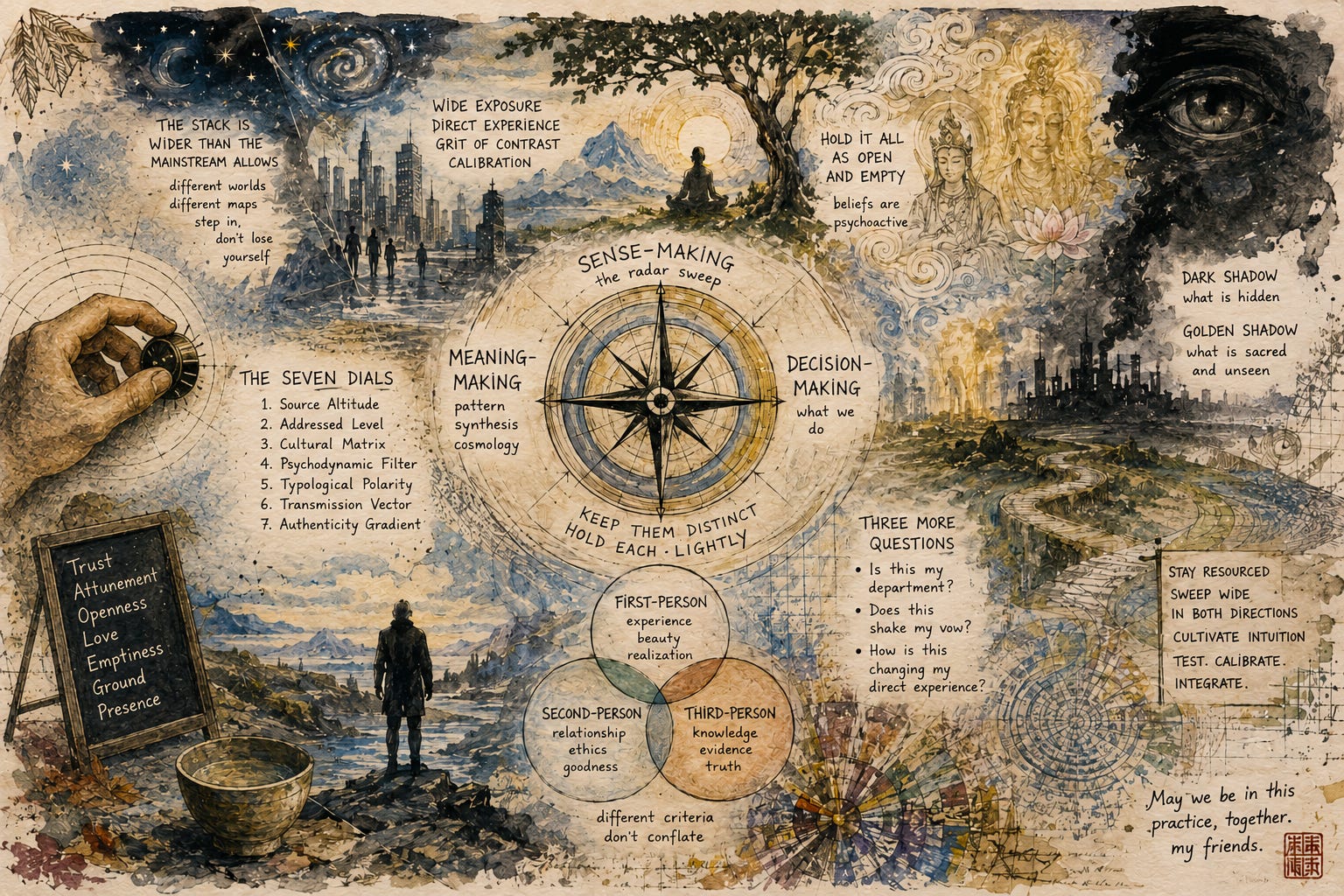
Recently we held an open community call on sense-making sparked by feedback from a student during a Bodhisattva’s Compass session that had ventured into edge-of-knowledge territory. The feedback was a gift. It forced us as a collective to articulate openly what we actually mean when we say sense-making — and how we go about it when we’re doing it well.
What follows is a synthesis of that conversation. An attempt to put on the page what’s usually held as implicit.
We’re in funky times. Information’s coming at us faster than we can metabolize it — from sources of wildly varying altitude and intent, and from worlds the mainstream has, frankly, agreed not to see. The pressure of this moment produces a kind of cosmological vertigo. To find your footing in it, you need a practice (not a position).
Sense-Making, Meaning-Making, Decision-Making
One thing to name right at the start: these three aren’t the same thing.
Sense-making is the radar sweep — the wide intake of what’s actually out there in the world, across the full developmental range, from Amazonian shamans to ethno-nationalists, from the neoliberal consensus to the postmoderns, all the way up to the Turquoise tech at the leading edge of culture. To sense-make well, you need a lot of stock. You can’t discern a signal you haven’t yet heard; the radar sweep of sense-making deepens only through wide exposure, the grit of contrast, and the calibration of direct experience.
Meaning-making is what you do with the sweep — the pattern recognition, the synthesis, the cosmology you build from gathered material.
Decision-making is the third movement: what you actually do, in your life and your work, on the basis of meaning you’ve made.
Where this tends to go wrong: meaning gets made way too fast out of something that was just sense-making, and then decisions follow from a meaning that hasn’t earned its position. You collapse the three. The practice is to keep them distinct, and to hold each one lightly.
Hold It All as Open and Empty
Whatever you’re taking in, hold it as an open construct.
This isn’t relativism: not “everything’s true” or “nothing’s true.” The thing is, if you’re going to change your world, you’ve got to change the self that perceives it at the same time. The self-world construct arises together. They’re synonymous, in some ways. So if you grip a worldview tightly, you’re also gripping yourself tightly, and nothing new can land.
Beliefs are psychoactive. Worth noticing what each one actually does to your nervous system before deciding whether to keep it.
Resourced Metabolization
The psychological setup matters a lot here. Sense-making, when it goes deep, is going to reorganize the self that’s doing it. New information — especially information about how the world actually works, or about the depth of the sacred — isn’t just information. It restructures you. And if you don’t have a sense of ground, you’re either going to reject everything new, or grab it too quickly as identity. Neither one works.
The conditions for genuine sense-making are trust, attunement, and openness. The resources that make these possible are specific:
Good attachment. The felt-sense of being held by a deeper ground.
Personal security. Stable enough material life to think clearly.
Cosmological security. A working relationship to ultimate questions — not certainty, but a stable orientation.
A strong enough sense of self. Not rigid, but coherent. The witness has to have somewhere to stand.
Deep love. The medium that lets shadow be metabolized rather than just absorbed.
Emptiness. The capacity to see structures (including self-structure) as constructs, not identities.
To these, add the be-here-now skills: mindfulness, presence, embodiment.
The practice is to face material while resourced. Not gung-ho — that’s bypass dressed up as courage. Not avoidant — that’s bypass dressed up as caution. The path is the willingness to look at what wants to be seen, when there’s enough ground to look from.
The Stack Is Wider Than the Mainstream Allows
Every developmental stage has a world. And every academic discipline has both what it lets into the mainstream and what it leaves out.
In psychology (my own field), I’d estimate the mainstream lets in maybe less than half of what a real sacred academy would include. And my sense is the same gap exists across every discipline: chemistry, physics, medicine, mathematics. The official map is always partial.
And let’s remember: memes are real worlds. When you move from one to another — from a neoliberal frame into UAP research, or into esoteric Christianity, or into integral theory, or into contemplative neuroscience — you’re not just entertaining a different opinion. You’re moving into a completely different world. Its own internal logic, its own evidentiary standards, its own felt sense of what’s plausible. So disorientation, when it happens, is appropriate. Pretending otherwise is, I think, what leads people to either bounce off in dismissal, or fall in too fast.
Sense-making, as a contemplative practice, includes learning to feel that gap between the official maps. And learning to step into other worlds without losing your own.
Pre-Rational and Trans-Rational
This is where Ken Wilber’s pre/trans fallacy becomes really important. Both pre-rational and trans-rational experiences sit outside ordinary rational thought — which means, to the rational mind, they can look identical.
The key to remember is that genuine trans-rational insight has passed through reason and will submit to examination. It doesn’t ask you to abandon careful thinking — it actually invites you further into it. Pre-rational experience, on the other hand, kind of regresses around reason. And from the inside, it can feel just as revelatory and certain.
So a rainbow body, for example, could be transrational psychosomatic technology — or it could just be a fairy tale. The discernment is which, and that takes work. The test is whether the claim, the experience, or the framework will sit still under examination, or whether it requires you to suspend the rational faculty in order to hold it.
Dark Shadow and Golden Shadow
The mainstream lets in a narrow band. Outside that band, in both directions, are realities the culture has agreed not to see.
On one side, the dark shadow — the unconscious of the collective psyche. Sociopaths exist in every nation. Power structures that don’t want to be seen. Things genuinely hidden, sometimes deliberately so.
On the other, the golden shadow — the buddhas and bodhisattvas, the guides and beings, the support and sacred world and beauty that would just stun you. Equally real, equally excluded from the official story.
Healthy sense-making expands in both directions at once. Holding more of the difficult stuff is only sustainable if you’re also opening to more of the support. They balance each other.
First, Second and Third-Person Knowing
The other thing — and this one’s subtle — is that first-person experience, second-person relational knowing, and third-person knowledge are different kinds of knowing. Different criteria entirely. And conflating them is one of the most common failures we see in contemplative communities.
A genuine first-person realization — a breakthrough into emptiness, a direct encounter with the sacred, a moment of clarity that reorganizes your sense of self — is real. It’s its own kind of knowing. But realization doesn’t mean everything you now know is correct. The realization tells you about the nature of mind, or the nature of being. It doesn’t tell you who’s running which power structure, what’s happening in a laboratory, or whether a particular cosmological story is historically accurate.
There is also a second-person dimension of knowing: the relational field of trust, ethics, care, attunement, and mutual recognition. Some things are known through participation with others — through dialogue, compassion, integrity, and the quality of relationship itself. This is the domain of goodness. Whether something deepens relationship, increases dignity, strengthens mutuality, or supports wiser participation in the world involves different criteria.
There are different criteria for what’s true, what’s beautiful, and what’s good. Third-person truth claims about the world have to meet third-person standards — evidence, coherence, falsifiability. First-person experience tells you something about beauty, meaning, depth, and the nature of consciousness. Second-person knowing asks what something does between beings. The fact that something is beautiful, or that it landed for you in deep practice, doesn’t make it true. And the fact that something is true doesn’t automatically make it good.
Crucially, you have to hold what’s true as empty too. Not because truth doesn’t matter, but because if you grip even truth too tightly, you can’t let new truths in. The contemplative move is to let what you know stay provisional, even when it’s well-grounded.
The Seven Dials
When new material arrives — a video, a book, a teaching, a story — there are at least seven dials I find myself turning to clean up the signal.
1. Source Altitude. From what depth of realization does this come? Egoic, psychic, soul, trans-soul? Does it carry love-wisdom and humility, or glamour and control?
2. Addressed Level. Who is this for? Mythic, rational, pluralistic, integral? A high being often simplifies for beginners. A beginner often inflates to sound advanced. The two can look similar from the outside.
3. Cultural Matrix. What’s the symbolic code — Tibetan, Christian, scientific, psychological? What does that code reveal, and what does it obscure?
4. Psychodynamic Filter. What unconscious material is shaping the transmission? What wounds, projections, compensations? And — crucially — what are mine as the receiver?
5. Typological Polarity. What energetic tone predominates? Solar or lunar, masculine or feminine, ascensional or incarnational? This often explains why a teaching attracts or repels you before content is even processed.
6. Transmission Vector. Through what vehicle is the wisdom moving? Text, ritual, video, embodied teacher, AI-mediated channel? Each medium colors the light.
7. Authenticity Gradient. How coherent, humble, compassionate, and reality-anchored is this? Does it integrate the receiver, or inflate them?
When all seven are attuned, comparison becomes comprehension. Different teachings stop competing for true-versus-false and show up instead as different refractions of one light through different prisms.
Three More Questions
The seven dials calibrate the signal. Three further questions calibrate your relationship to it.
Is this my department? You’re not required to be deep on every domain. If you’re working in childhood education, you probably aren’t an esoteric physicist — and there’s no reason you should be. Different departments have different interests. Curiosity is real and worth honoring, but so is the discipline of staying with your actual work. Not every rabbit hole is yours.
Does this shake my vow? If a piece of material is rattling your sense of vow for a world that’s good and true and beautiful, that’s information. Sometimes it means the material is genuinely destabilizing. More often it means the vow isn’t yet strong enough not to be disturbed by it. Either way, it’s a flag worth noticing — and a signal about whether engaging with this material is yours to do at this stage.
How is this changing my direct experience? Especially useful in periods of deep psycho-spiritual transformation. Treat this as a separate question from “is it true.” Even if it’s true, it might not be the time for you to go down that rabbit hole. You can always circle back later. Your direct experience — your nervous system, your relationships, your capacity to function and love and act — is itself a form of evidence about what’s metabolizable for you right now.
Cultivating the Intuition
None of this, by the way, is purely cognitive. The deeper capacity at work is what the Buddhists call Buddhi — direct, non-conceptual valid cognition. The ability, basically, to know shit without knowing how you know it.
And it’s developmental. You build it by testing it. You take an intuition into a domain you actually know — your field, your work — and check it against what’s verifiable. Get feedback. Calibrate. Do it again. Over years, the signal-to-noise gets better.
A useful refinement: domain-specific trust transfer. You can’t be an expert in everything, so you identify who does good sense-making in which domains, and you pay particular attention to where credible sources disagree. That’s where the real edges are. A working sense of a domain often comes faster from understanding the live disagreements within it than from trying to learn the whole field from scratch.
Epistemological Humility
So — you hold what you take in lightly. You stay resourced. You sweep wide, in both directions of the shadow. You distinguish realization from knowledge, beauty from truth, what passes through reason from what regresses around it. You calibrate the signal with the dials, and your relationship to it with the further questions. Together, this is one practice.
What we want, finally, is epistemological humility — held alongside the courage to actually look. To actually try things. To actually build. To become the kind of practitioner who’s learning how to think, not what to think. How to question, not just what to question.
The world is going to get funkier. Things our culture has agreed don’t exist will start showing up in laboratories. AI already looks like magic to most people, and the developers don’t fully know how it works. The pressure of this moment is also producing higher-order complexity — that’s the gift inside the difficulty.
The dials of discernment and the practice of sense-making are how we stay calibrated as the territory shifts.
May we be in this practice, together, my friends.
If you feel the pull of this vow and want to walk the Bodhisattva path with us in a deep, sustained way, we offer a two-year flagship training. It weaves mature human development, attachment healing, and contemplative practice into an integrated path. Learn more here.
And if you’d like a lighter-touch, monthly rhythm of engagement with the teachings, The Gateway is our community membership. It’s designed to welcome new students and support ongoing practitioners through practice, dialogue, and relationship with the lineage, including monthly Bodhisattva’s Compass conversations with John Churchill.
Dr. John Churchill is the founder of Planetary Dharma, a contemporary Bodhisattva training school integrating perennial wisdom, contemplative practice, attachment healing, and adult development.
 | A guest post by
|
Thanks--I found this very helpful!
As for the shadow mentioned, I am used to working at a more personal level with trained shadow work facilitators, and wonder if this might better precede what you discuss?
The dark shadow becomes obvious. But the golden shadow is that wonderful aspect of yourself you didn't realize and others point out. I did this work in a men's initiation workshop called "the New Warrior Training Adventure." Learn more here: mkp.org